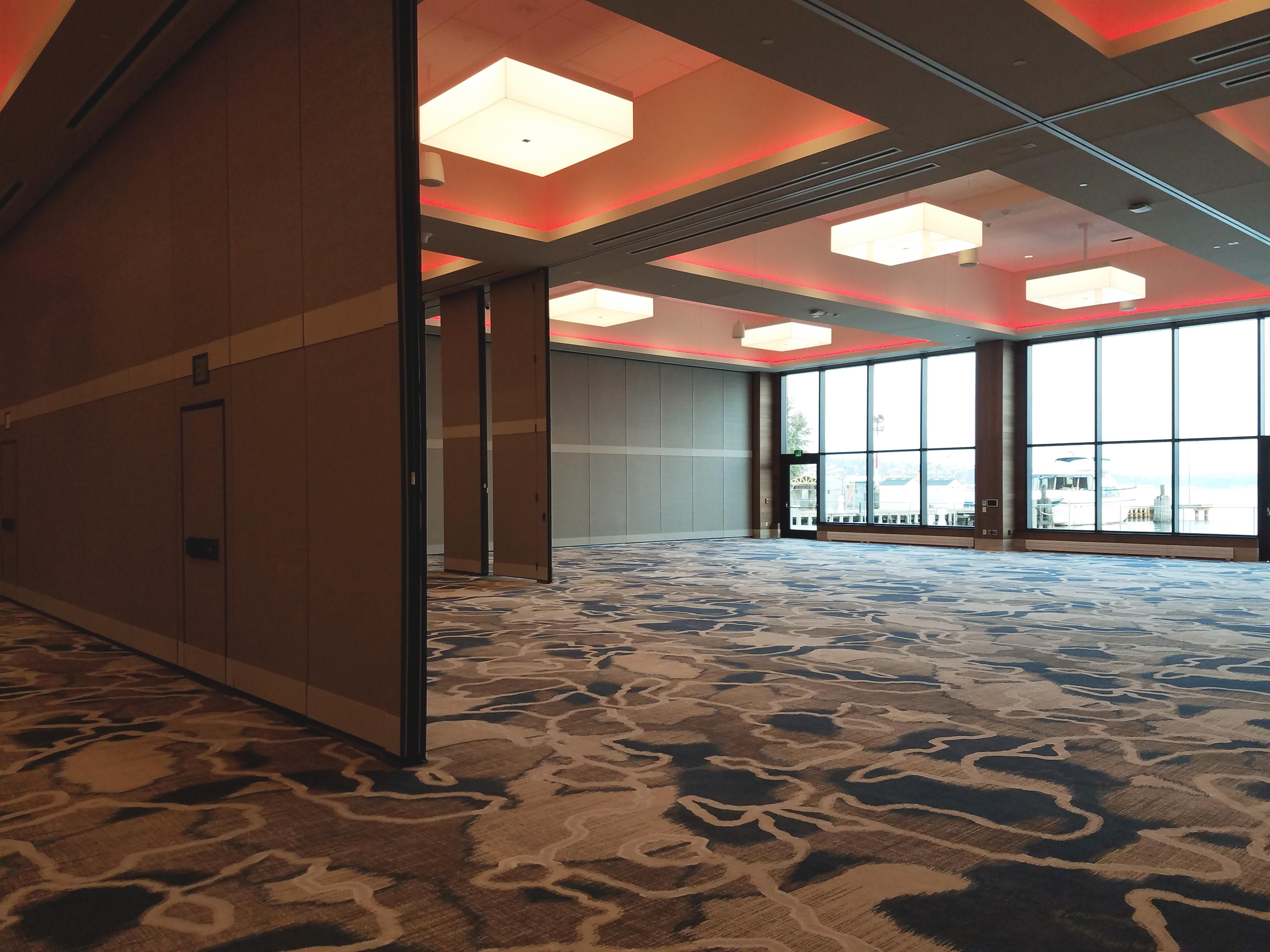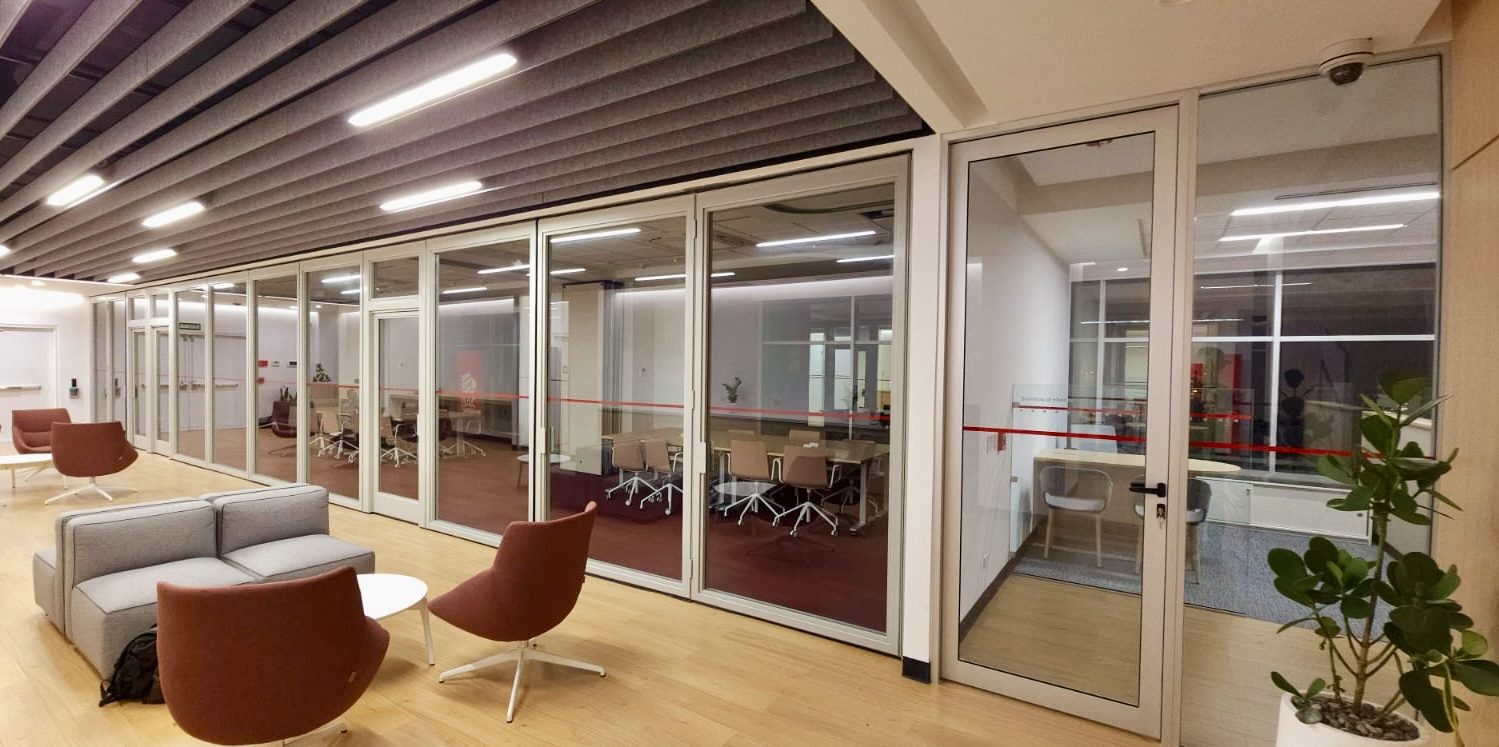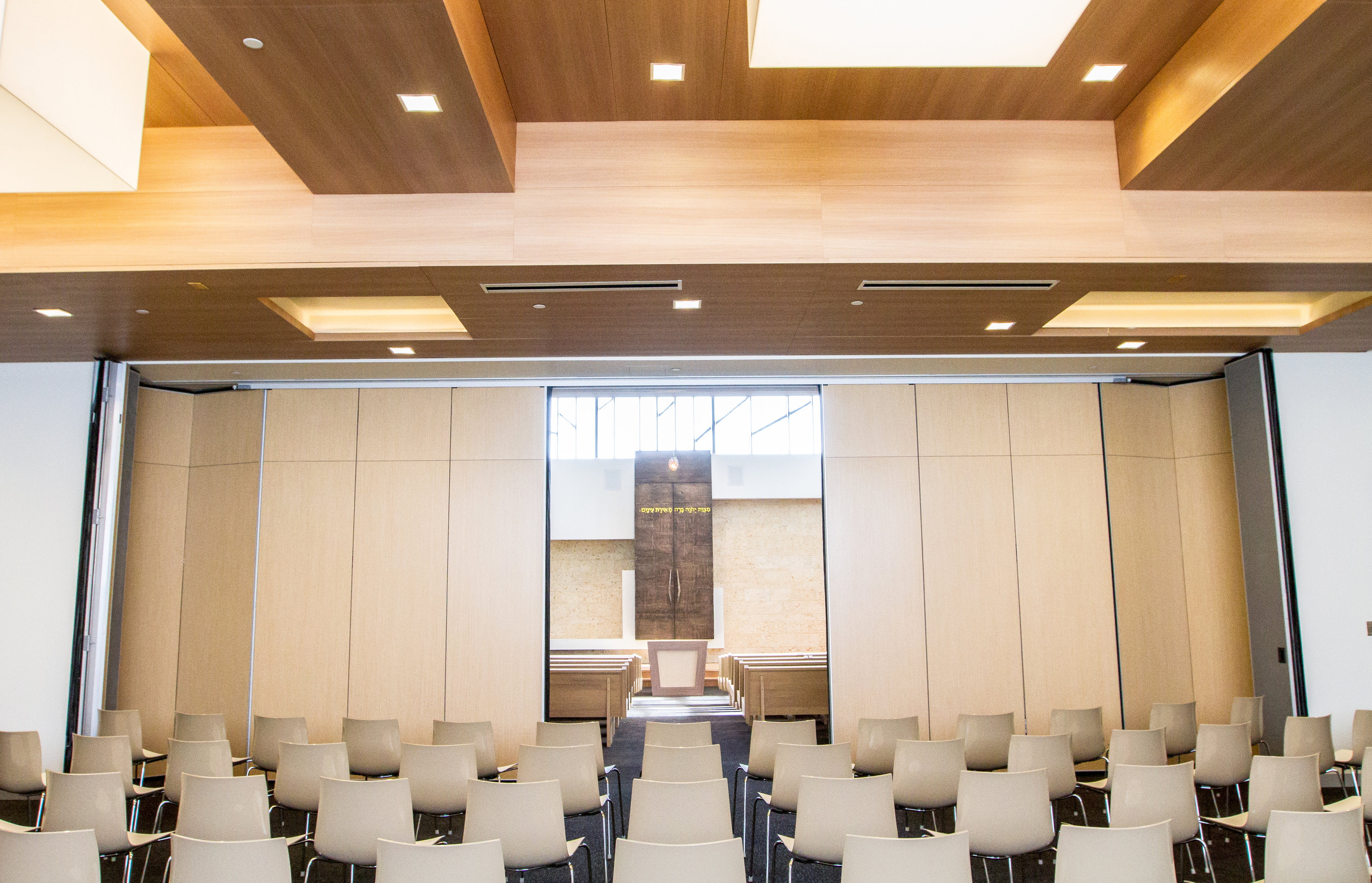

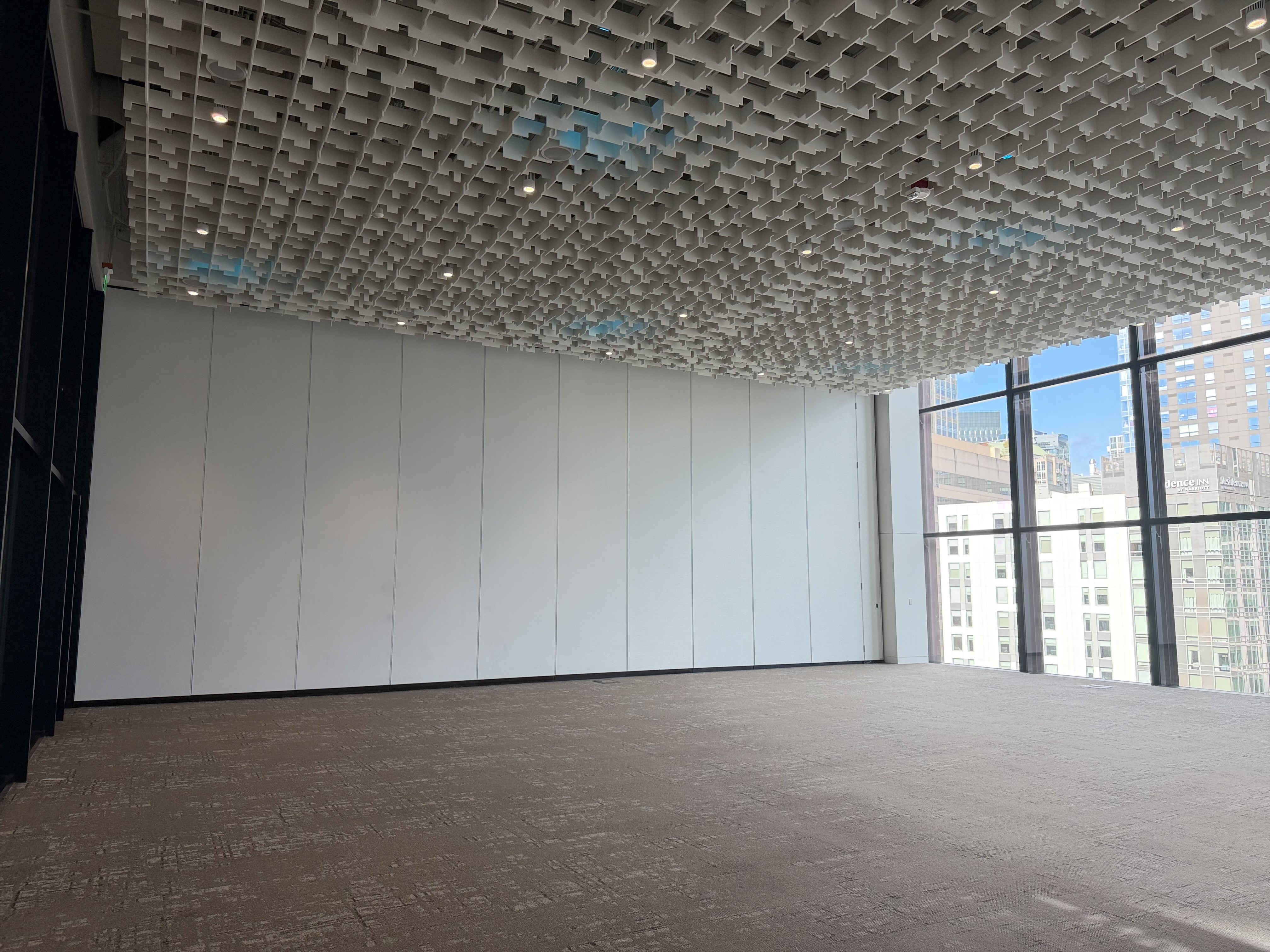
Every operable partition looks similar in a rendering: big flat panels, a track overhead, a neat stack at the end of the run. What separates a wall that still glides and seals after thirty years from one that rattles after five is invisible in that rendering — it is how the panel itself is built.
Two ways to build a panel
Most operable partitions on the market are built as a metal frame carrying gypsum-based face layers — essentially drywall in a steel jacket. It is an economical construction, but the faces are attached rather than structural, and gypsum does not love impact, moisture, or decades of movement.
Advanced Equipment builds the other way: all-welded, all-steel panels. Heavy 16 or 14 gauge steel faces are robotically fusion-welded to the perimeter frame every 8 inches, so the entire panel — faces and frame together — works as one rigid structural unit. No gypsumboard anywhere in the panel.
Why welded steel matters for sound
Acoustic performance is mostly mass and stiffness, and a fusion-welded steel panel delivers both. ALPHA® series panels carry laboratory ratings up to STC 54, and because the construction performs predictably in real buildings, Advanced Equipment guarantees field sound ratings on its large operable walls — ALPHA panels field-test at NIC 42 under ASTM E 336. If those acronyms are new, our guide to STC, NIC, and NRC explains them in plain language. Acoustically absorptive faces to NRC 0.65 are available where the room needs the wall to soak up sound, not just block it.
Why it matters for size
A panel that works as one welded unit can simply be bigger. Advanced Equipment builds one-piece panels to 46 feet high and 60 inches wide, with two-piece field-spliced panels to 60 feet — the reach convention centers and exhibition halls require — and is the only manufacturer offering true curved steel panels running on curved track, so the wall can follow the architecture instead of forcing straight runs.
Why it matters over decades
Operable walls are opened, closed, bumped by carts, and leaned on by crowds — for decades. Steel faces shrug off the daily abuse that cracks and crumbles gypsum cores, which is why ALPHA series panels carry 10 or 20 year limited panel warranties depending on configuration, and why walls we installed a generation ago are still in daily service.
Construction also decides what happens at the end of a finish's life. Because the steel panel is structural, worn faces can be refurbished — new finishes on the same panels — instead of replacing the whole wall.
A greener panel, certifiably
Because ALPHA and SIGMA panels are built without gypsumboard, they qualify for LEED Credits MR 4.1 and MR 4.2 — a specification point that gypsum-core walls cannot match.
Finishes: what goes on the steel
The structural panel takes almost any face the design calls for: standard vinyl (Type II, Class A fire rating), Hytex woven fabrics and rib wallcovering, Wilsonart high-pressure laminate in 35+ colorways, and Writanium® porcelain-on-steel markerboard surfaces that turn the wall into dry-erase workspace. Full finish specifications are downloadable in the document library.
How to check construction before you specify
Three questions expose a panel's construction quickly. How are the faces attached to the frame — welded, or fastened? What is the panel warranty — 20 years is only possible when the manufacturer trusts the structure. And will the maker guarantee a field sound rating, not just quote a lab number? Ask for the sound test reports — ours are in the document library — or build a complete specification in six steps with DWspec®.
Planning a project? Send us the details — we design, weld, and install every panel ourselves in Fullerton, California, and have since 1957.