

Convention Center Operable Partitions
Flexible Spaces for World-Class Events
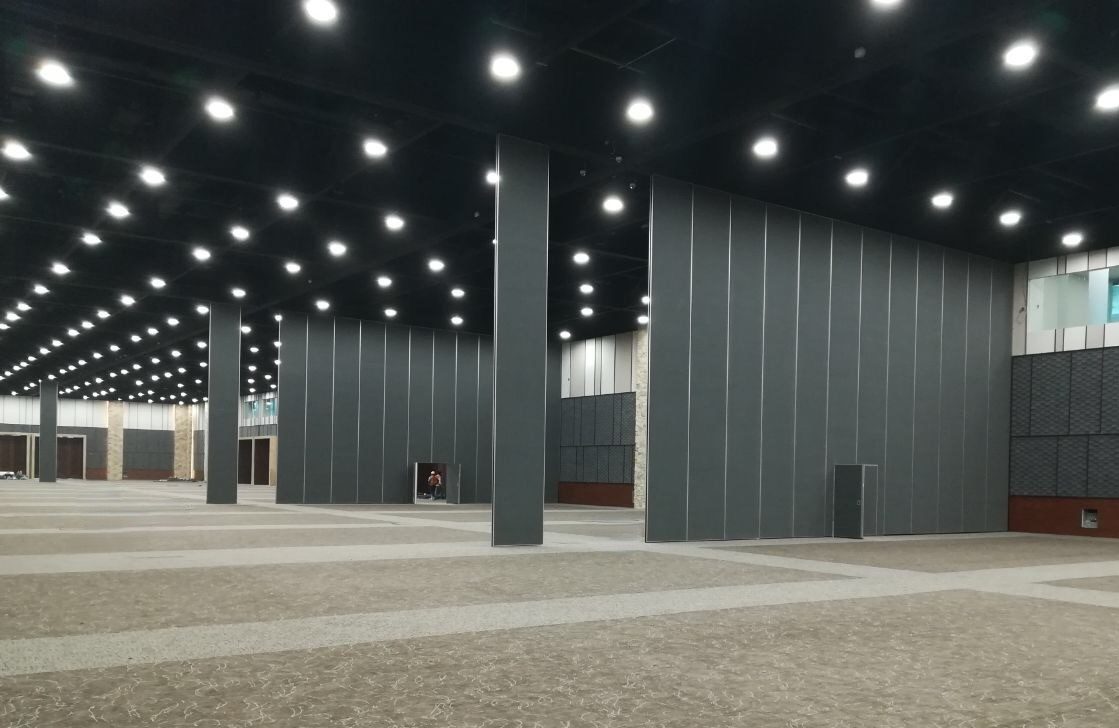
Large-scale operable partition systems engineered for convention centers, exhibition halls, and event facilities requiring maximum flexibility and efficiency.
Why Convention Centers Choose Advanced Equipment
High-Volume Operation
Engineered for frequent use with heavy-duty construction and Spacematic automation for quick room reconfigurations.
Massive Coverage
Large-span track systems support partition walls across openings of any size, delivering superior acoustic performance with ratings up to STC 54.
Power Assisted
Spacematic automation reduces setup time by up to 80%, allowing staff to reconfigure spaces in minutes instead of hours.
Built for Large-Scale Events
Advanced Equipment's operable partition systems are the preferred choice for convention centers worldwide, offering unmatched durability, acoustical performance, and operational efficiency.
Acoustical Excellence
Field-tested NIC 42 under ASTM E 336, laboratory STC to 54, for superior sound isolation between event spaces
Manual Operation
Smooth, manually operated systems for reliable and flexible space division
Electric Operation
Power-assisted electric systems for effortless one-touch space reconfiguration
Life-Cycle Durability
All-welded steel frames designed for decades of reliable service
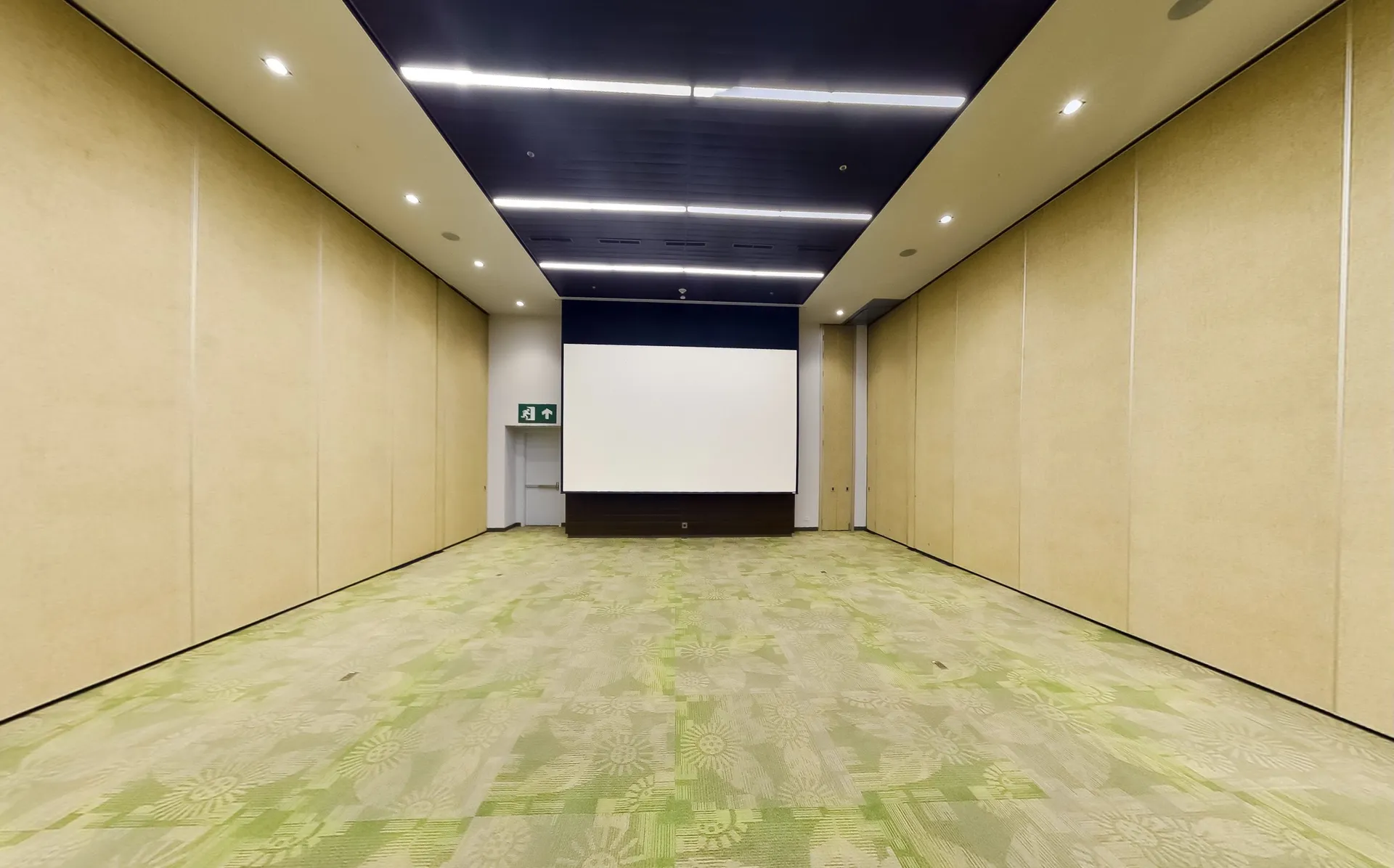
Operable walls at convention-center scale
Convention center partition work is not ballroom work with bigger numbers. Past a certain span the constraint stops being the wall and becomes the labor and the clock: how many staff, and how many minutes, stand between the configuration you have and the configuration the next event needs. Everything below is organized around that.
The scale is real. Seattle Convention Center Addition, designed by LMN Architects and completed in 2023, divides 434,988 square feet of event space with all-steel, all-welded ALPHA and SIGMA panels carrying up to a 20-year warranty. Jacob Javits Convention Center in New York totals 186,446 square feet across three separate projects between 2013 and 2021 — one of Advanced Equipment's largest convention center installations in North America. Those two projects alone are more operable wall than most manufacturers install in a decade.
At that size, automation is the answer to the labor problem. Javits combines manual operation with Spacematic® automated ALPHA series panels and remote storage. Savannah Convention Center's 2023 expansion — TVS Design, built by Clark Construction Group — runs all-welded ALPHA 'T' panels on #1 and #2 track across the expanded hall and breakout rooms, with Spacematic on the exhibit-hall dividers specifically so staff can reposition full-length panel runs between events without handling them. Cal Poly San Luis Obispo uses the same automation at smaller scale. Spacematic is patented, driven by a low-voltage planetary gear motor under a programmable processor, and moves individual panels into virtually any configuration required — the published figure is up to 80% less setup time, which in a venue turning a hall twice a day is the entire operating case. Spacematic automation covers how it works.
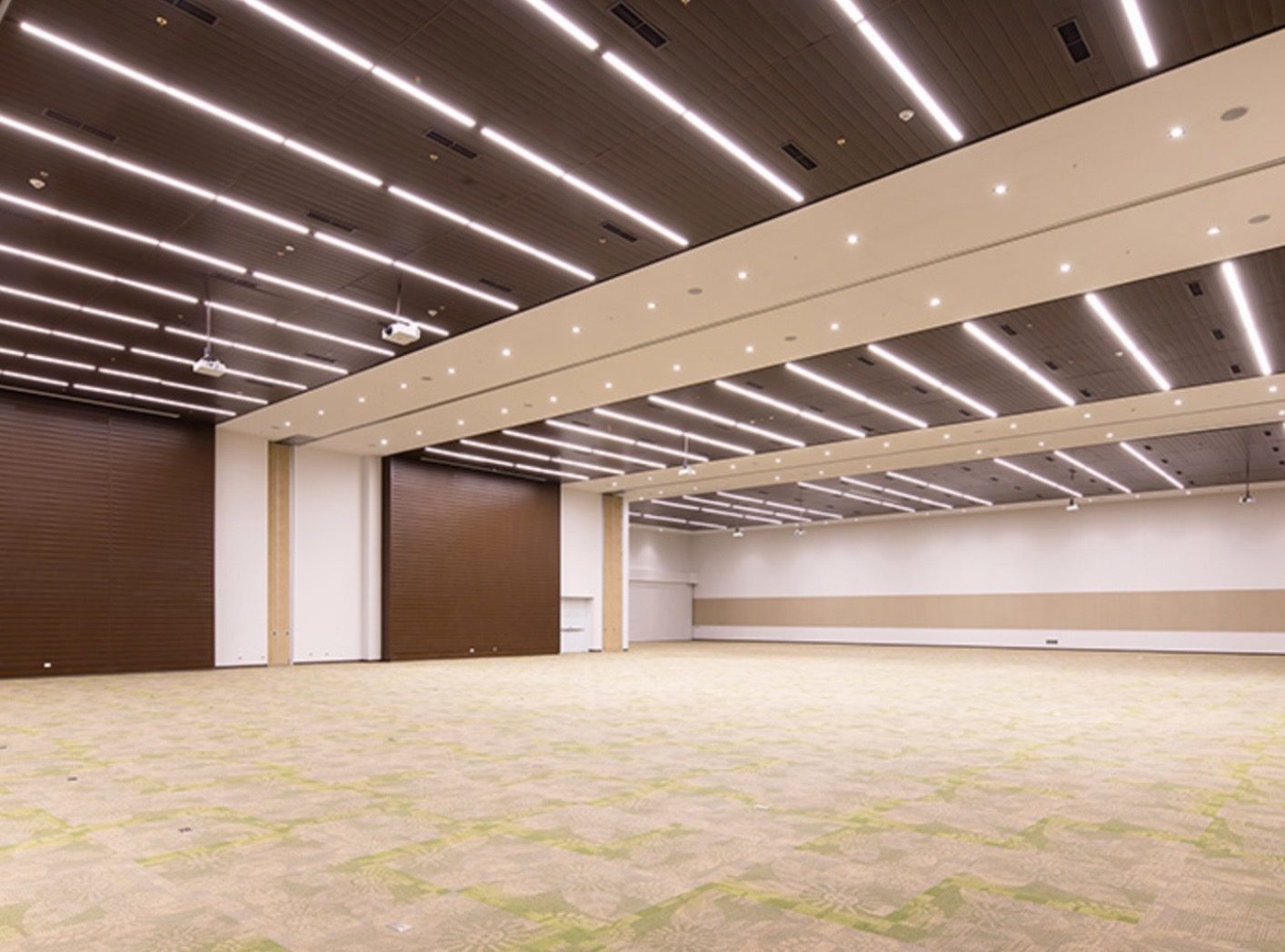
The systems are almost never uniform, and that is deliberate. Costa Rica Convention Center in Heredia — Gensler, 2017, 12,979 SF — runs three distinct systems in one building: manual remote ALPHA 'U' panels on #8 Super Track for ballroom subdivision, remote-operated SIGMA 'E' on #1A track for mid-size perimeter breakouts, and electric ALPHA 'X' on #1 track where spaces get reconfigured most often, all in a single standard vinyl finish so the building still reads as one interior. Tijuana Convention Center pairs electric ALPHA 'U' on #6 track with manual SIGMA 'C' across 33,999 SF in two-tone vinyl. Matching the system to the room, rather than buying one system for the building, is what keeps a venue from paying for motors it does not need or fighting a manual wall it should have automated.
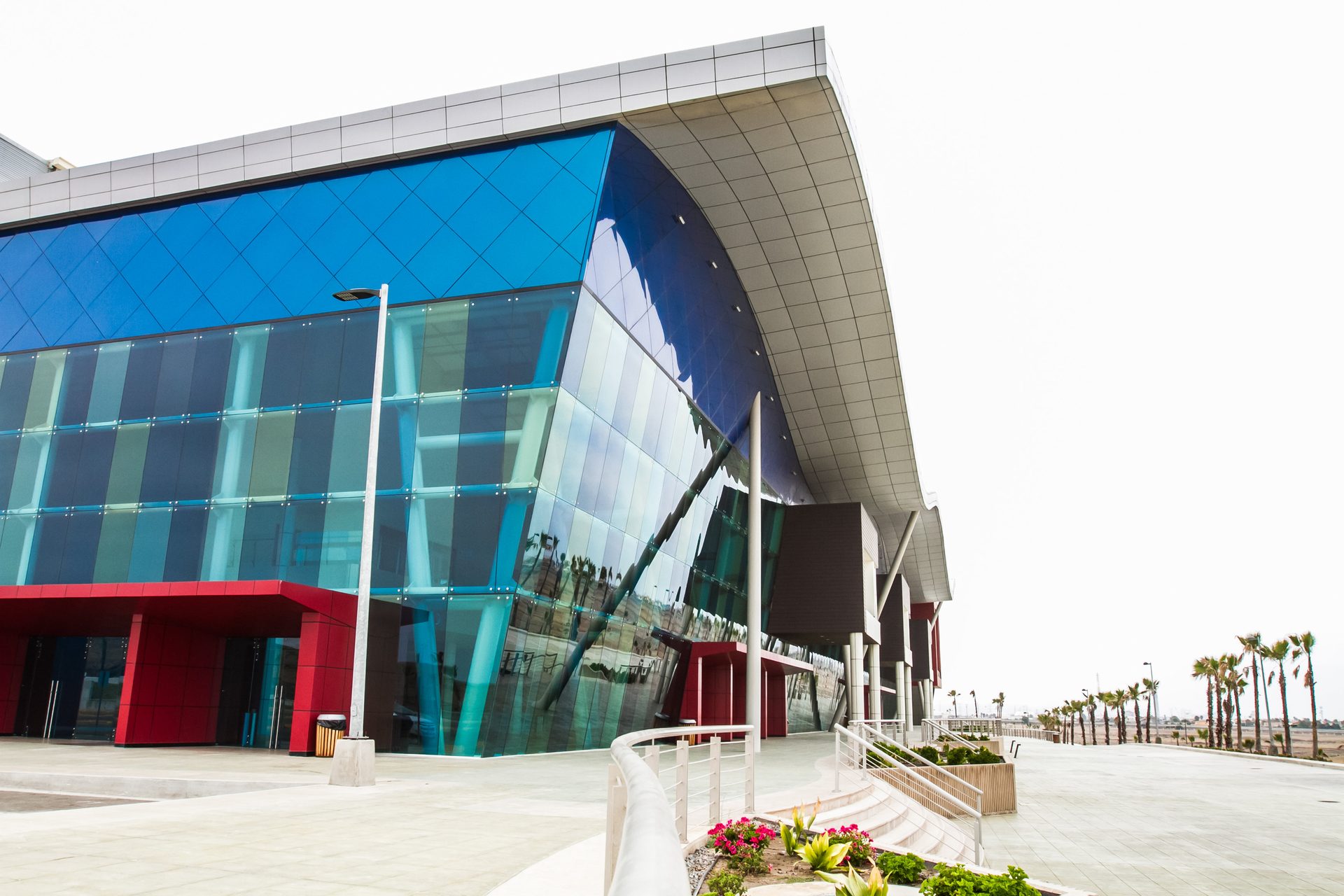
Where the panels go when the hall is open matters as much as how they close. Yucatan Convention Center divides 30,270 SF with manual SIGMA 'E' panels on #1 track using remote storage with pocket doors, so the stacks are concealed entirely and the open floor stays open. Javits uses remote storage for the same reason at ten times the area. A remote stack costs more in track and space planning and pays it back every day the room is used at full capacity.
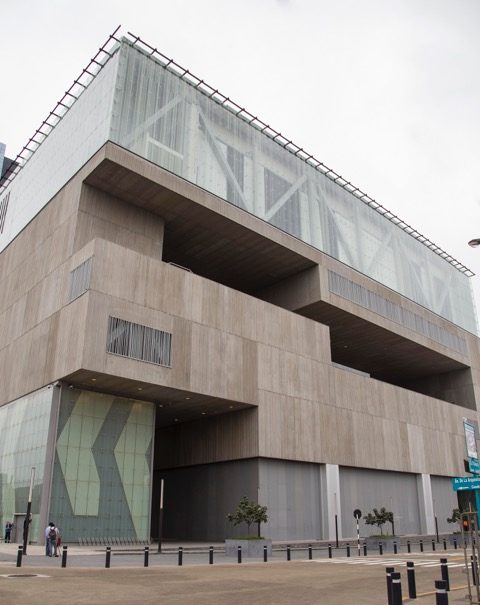
Track selection is the quiet driver of everything above. Conventiones Lima in Peru uses a mix of #1A, #2 and #8 track across 15,374 SF precisely because its ballrooms and conference halls have different spans — and the same project puts ALPHA 'P' panels to work as large-format exterior wall elements, which is well outside standard interior partition use. Our track systems are manufactured in nine types, each with its own weight capacity; the panel you want dictates the track, and the track dictates the structure above it. Operable partition track systems explains the selection.
On acoustics, the field-tested rating is NIC 42 under ASTM E 336, with laboratory ratings to STC 54, and we guarantee field sound ratings on our large operable walls — which is the number that matters when two general sessions run simultaneously and both are amplified. It is also worth knowing that a field NIC test locates leakage that has nothing to do with the wall: a hole in the barrier above the ceiling, or shared ductwork, will show up in the result. That is a feature, not a nuisance. See STC, NIC and NRC explained and the acoustics data.
Not every division has to be opaque. Savannah's expansion also includes Image Series glass wall panels so daylight still crosses a divided space — useful in prefunction and concourse areas where a solid wall would darken the room it created.
Advanced Equipment designs, manufactures, and installs its own systems and has done so since 1957 from Fullerton, California, with a second location in Woodinville, Washington. Our convention and exhibition portfolio spans New York, Seattle, Savannah, Tijuana, Yucatan, Lima and Heredia. For a venue in planning, tell us the openings and the turn schedule.
Convention center specifications at a glance
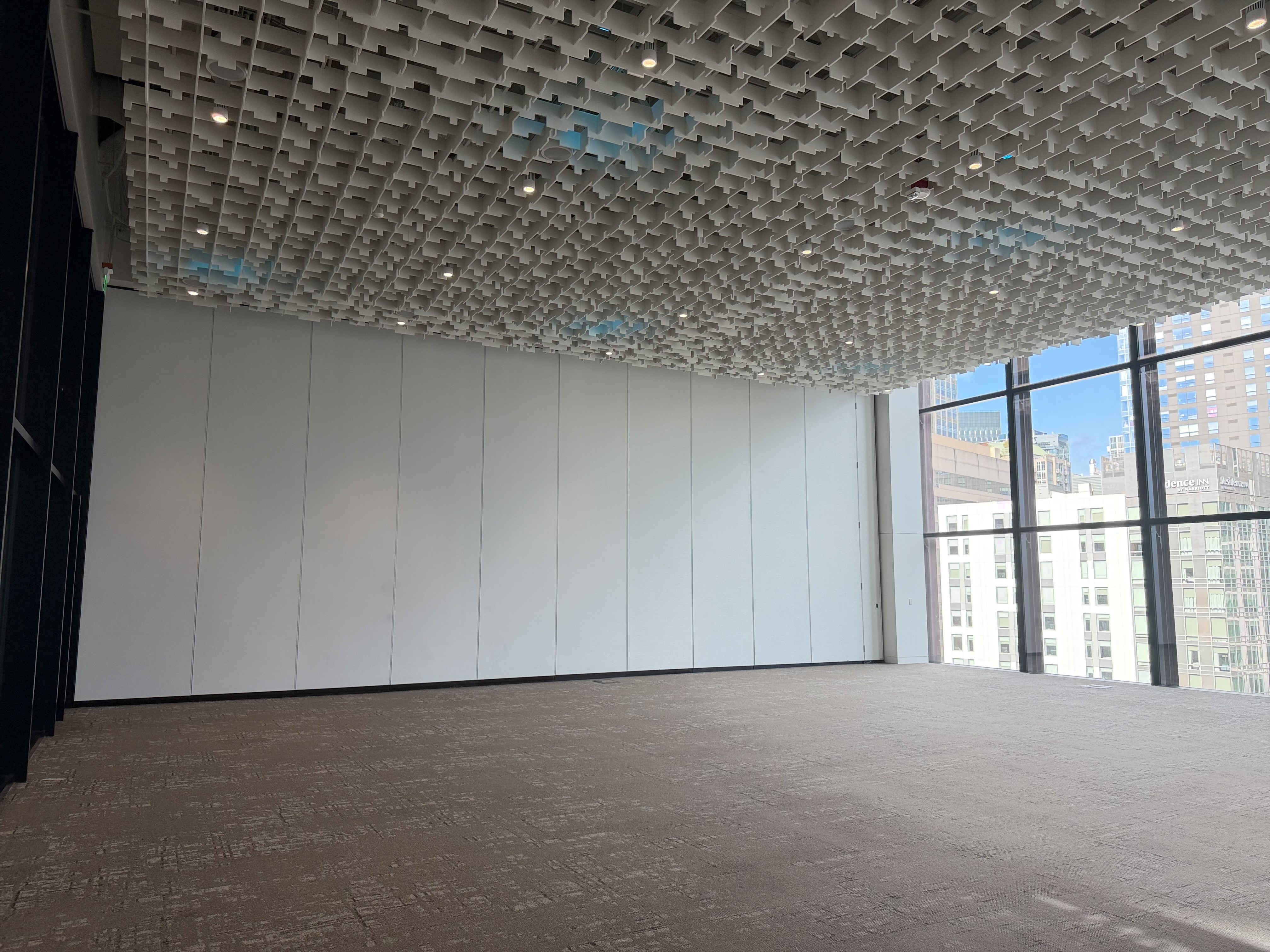
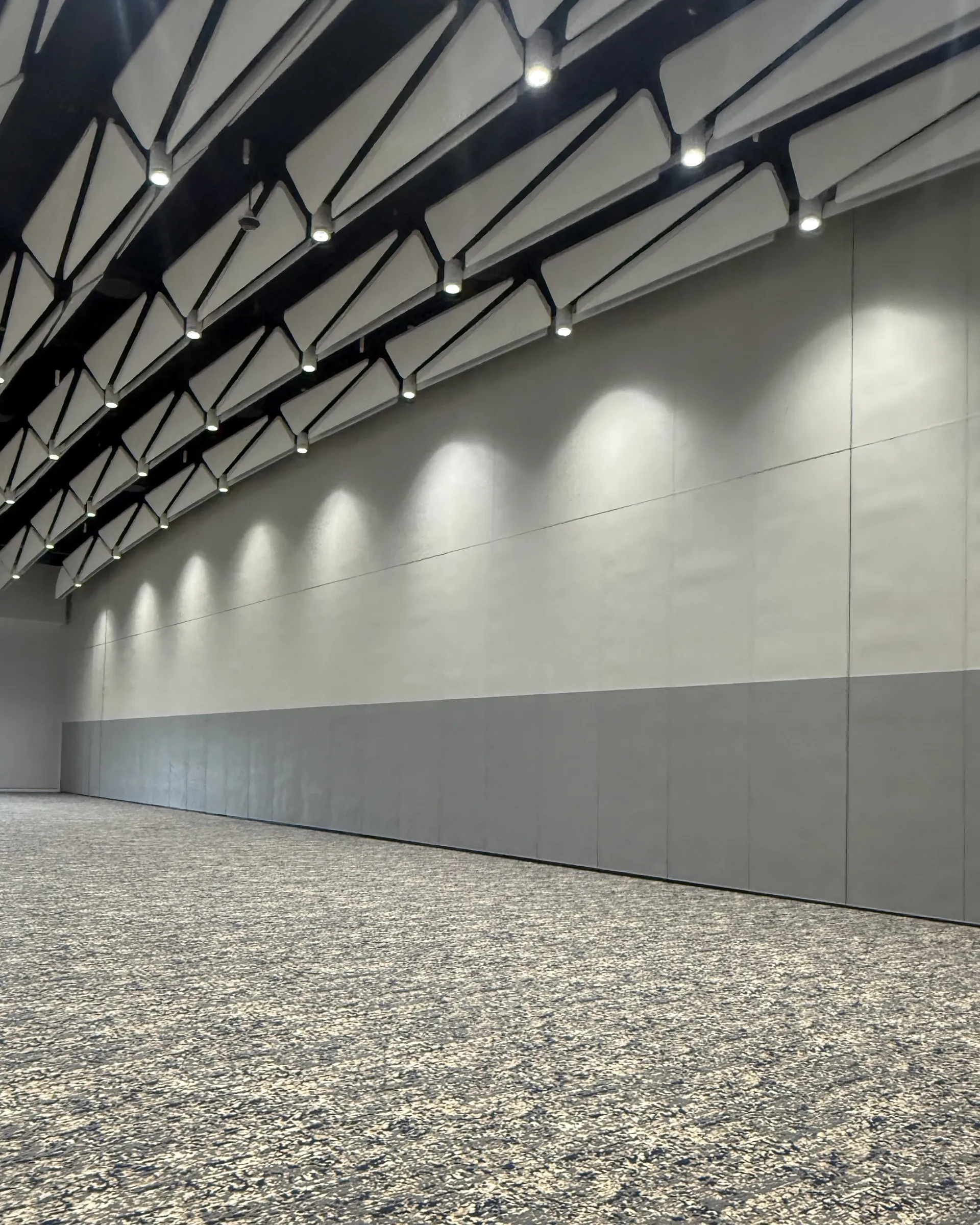
Convention Centers Projects
View All Projects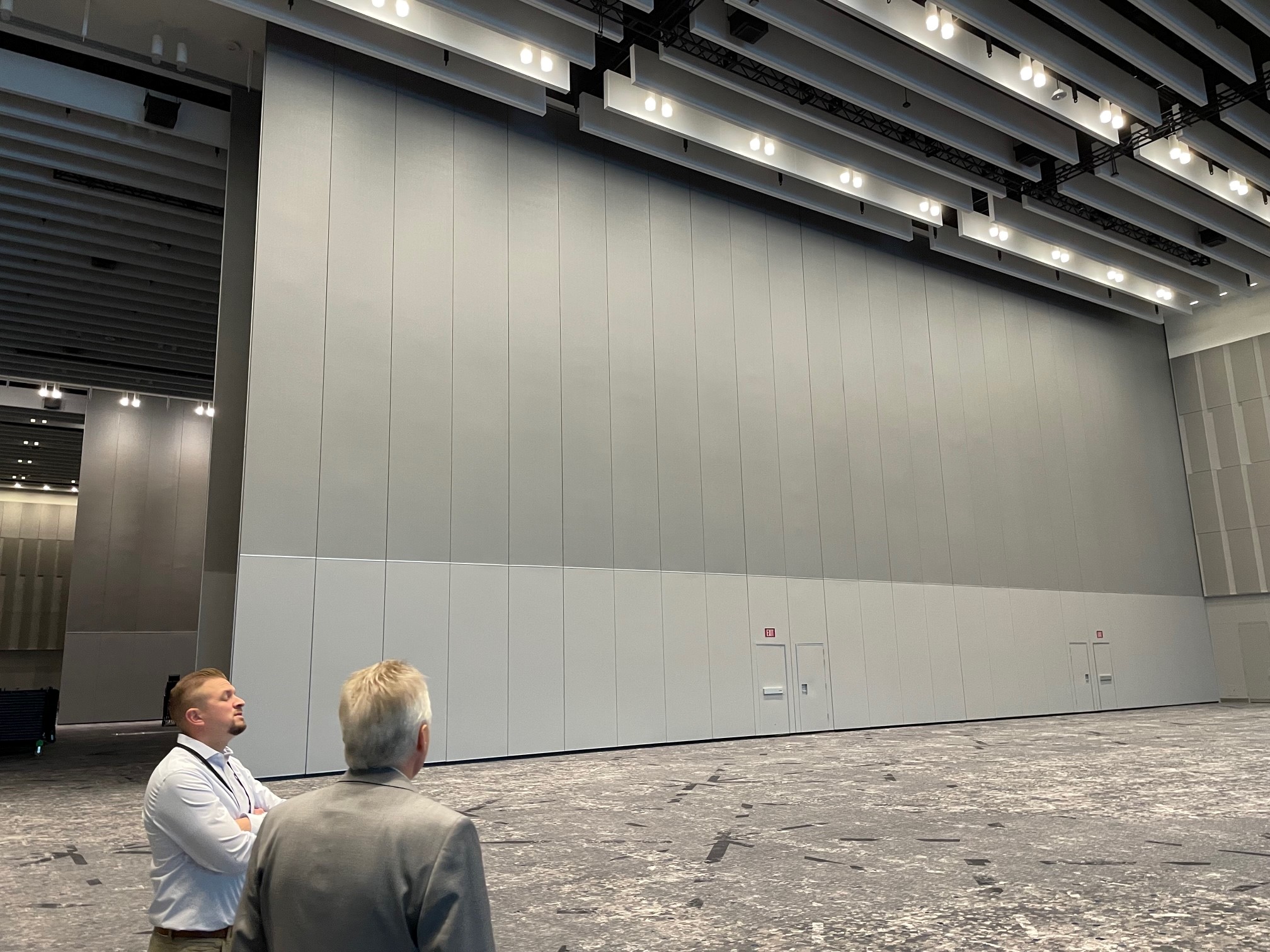
Questions venues ask us
How large an installation can you actually deliver?
The Seattle Convention Center Addition divides 434,988 square feet of event space, and Jacob Javits in New York totals 186,446 square feet across three projects from 2013 to 2021 — one of our largest in North America. Scale is a planning question for us, not a capability question.
How much staff time does automation actually save?
The published figure is up to 80% less setup time. Spacematic® is patented, driven by a low-voltage planetary gear motor under a programmable processor, and moves individual panels into virtually any configuration required — so a full-length run is repositioned without staff handling panels. Savannah put it specifically on the exhibit-hall dividers; Javits combines it with manual operation elsewhere in the same building.
Should the whole venue use one system?
Usually not. Costa Rica Convention Center runs three in one building — manual remote ALPHA 'U' on #8 Super Track for ballroom subdivision, remote SIGMA 'E' on #1A for perimeter breakouts, and electric ALPHA 'X' on #1 for the spaces reconfigured most often — all in one finish so the interior still reads as a whole. Matching system to room avoids paying for motors you do not need.
Where do the panels go when the hall is fully open?
Remote storage, usually with pocket doors concealing the stack. Yucatan Convention Center conceals its stacks entirely that way across 30,270 SF; Javits does the same at far larger scale. It costs more in track and space planning and returns it every day the room runs at full capacity.
Two general sessions, both amplified, back to back. Will they bleed?
Our field-tested NIC 42 under ASTM E 336, with laboratory ratings to STC 54, and we guarantee field sound ratings on our large operable walls. A field NIC test will also surface leakage that is not the wall at all — an unsealed barrier above the ceiling, or shared ductwork. Worth knowing before the test, not after. See the acoustics data.
How do we choose the track?
The panel dictates the track and the track dictates the structure above it. We manufacture nine track types, each rated to its own weight capacity. Conventiones Lima uses #1A, #2 and #8 in one building because its halls have different spans. Bring the openings early — operable partition track systems explains the selection.
Can a division let daylight through?
Yes. Savannah's expansion includes Image Series glass wall panels so light still crosses a divided space. That is often the right call in prefunction and concourse areas where a solid wall would darken the room it just created.
Do you work internationally?
Yes. Our convention portfolio includes Tijuana and Yucatan in Mexico, Conventiones Lima in Peru, and the Costa Rica Convention Center in Heredia, alongside New York, Seattle and Savannah. We operate from Fullerton, California and Woodinville, Washington and have delivered and serviced work across the United States and internationally — completed projects also include Chile, Egypt, China and South Korea.
Ready to Transform Your Convention Center?
Contact our team to discuss how our operable partition systems can maximize your facility's flexibility and efficiency.