

Operable Partitions for Places of Worship
Flexible Spaces for Growing Congregations
Acoustically-rated operable partition systems designed for churches, synagogues, temples, and community centers requiring flexible worship and fellowship spaces that adapt to varying congregation sizes.
Why Houses of Worship Choose Advanced Equipment
Versatile Worship
Create intimate settings for prayer groups or expand for full congregation gatherings with ease.
Community Spaces
Transform fellowship halls for weddings, funerals, receptions, and community outreach programs.
Sound Sanctity
High acoustical ratings maintain the reverence and privacy needed for spiritual gatherings.
Adapt to Your Space
Whether expanding for multiple services, hosting community events, or creating flexible fellowship spaces, our operable partition systems are engineered to fit the unique architecture and mission of your facility.
Superior Acoustics
STC-rated panels ensure sound privacy for concurrent services and meetings
Quiet Operation
Smooth, silent deployment that respects the sacred atmosphere
Customized Storage Options
Tailored pocket and stacking configurations to keep panels out of sight when not in use
Value-Oriented
Long-lasting construction respects stewardship of congregational resources
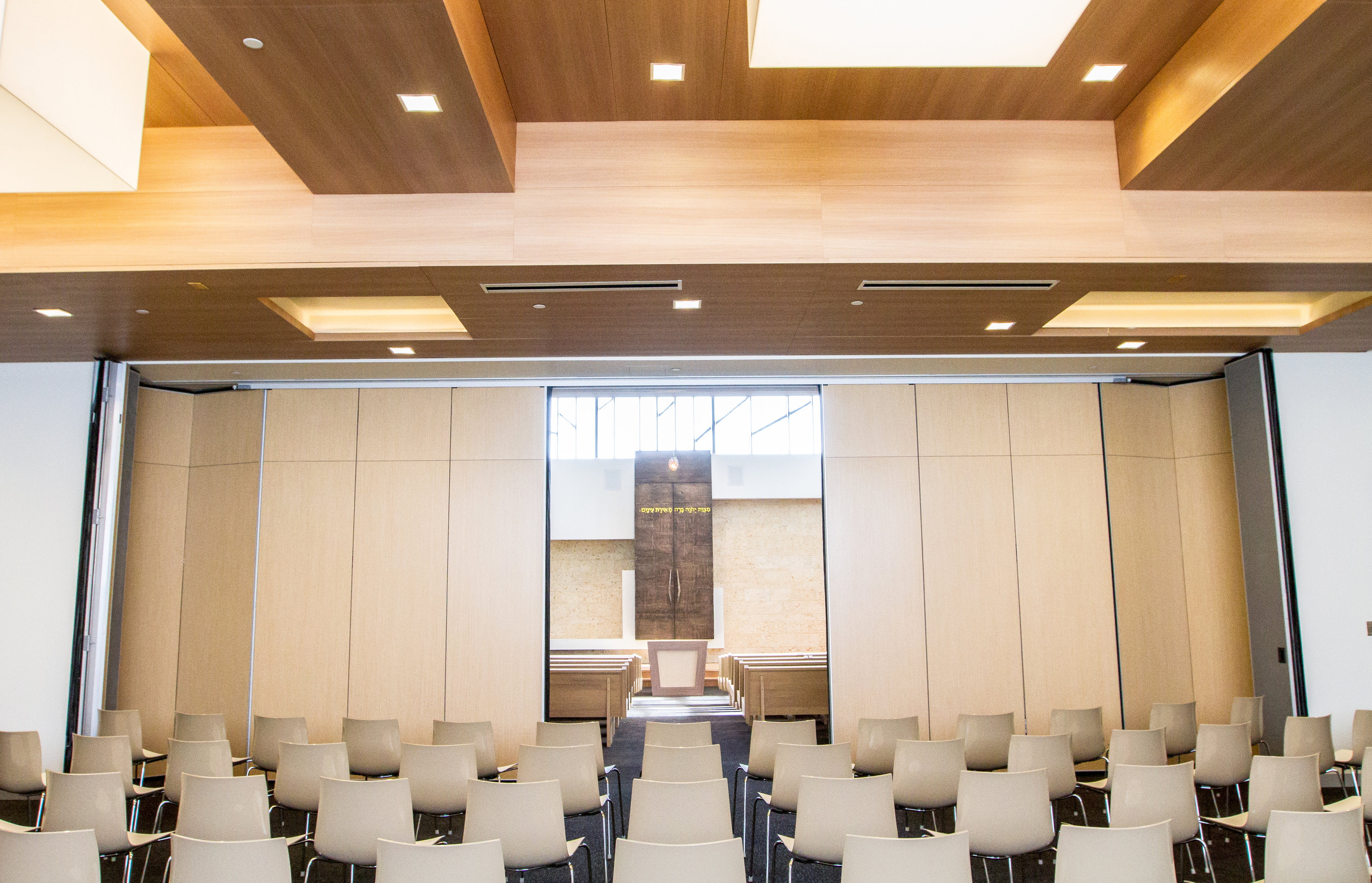
Worship Installations, Sanctuary to Fellowship Hall
Houses of worship ask an operable partition to do two things at once: disappear when the room is full, and hold acoustic privacy when it is divided. At Temple Israel in Long Beach, that meant a bi-parting electric wall in SIGMA 'C' construction alongside a second, manually operated partition — both running on #1 track. The custom wood veneer was matched to the temple's existing architectural woodwork, and concealed SOSS hinges on the pass doors keep the sight lines clean when the panels are stored.
Congregation Rodef Shalom in San Rafael took a different path for a different room. Designed by Herman Coliver Locus, the 1,751 SF installation pairs SIGMA 'E' panels in wood veneer and fabric with ALPHA 'P' perforated acoustic panels rated NRC .65. Manual paired panels with remote stack put the partitions completely out of sight when the sanctuary is needed at full capacity.
That NRC figure is the detail worth understanding, because it answers a different question than NIC and STC do. NIC and STC describe how much sound the wall stops between two rooms; NRC describes how much the panel face absorbs inside the room it is facing. A sanctuary with hard surfaces can be acoustically private and still be difficult to preach in. Absorptive faces to NRC 0.65 are available precisely for spoken-word clarity — we walk through the distinction in STC, NIC and NRC explained.
Worship Specifications at a Glance
Places of Worship Projects
View All Projects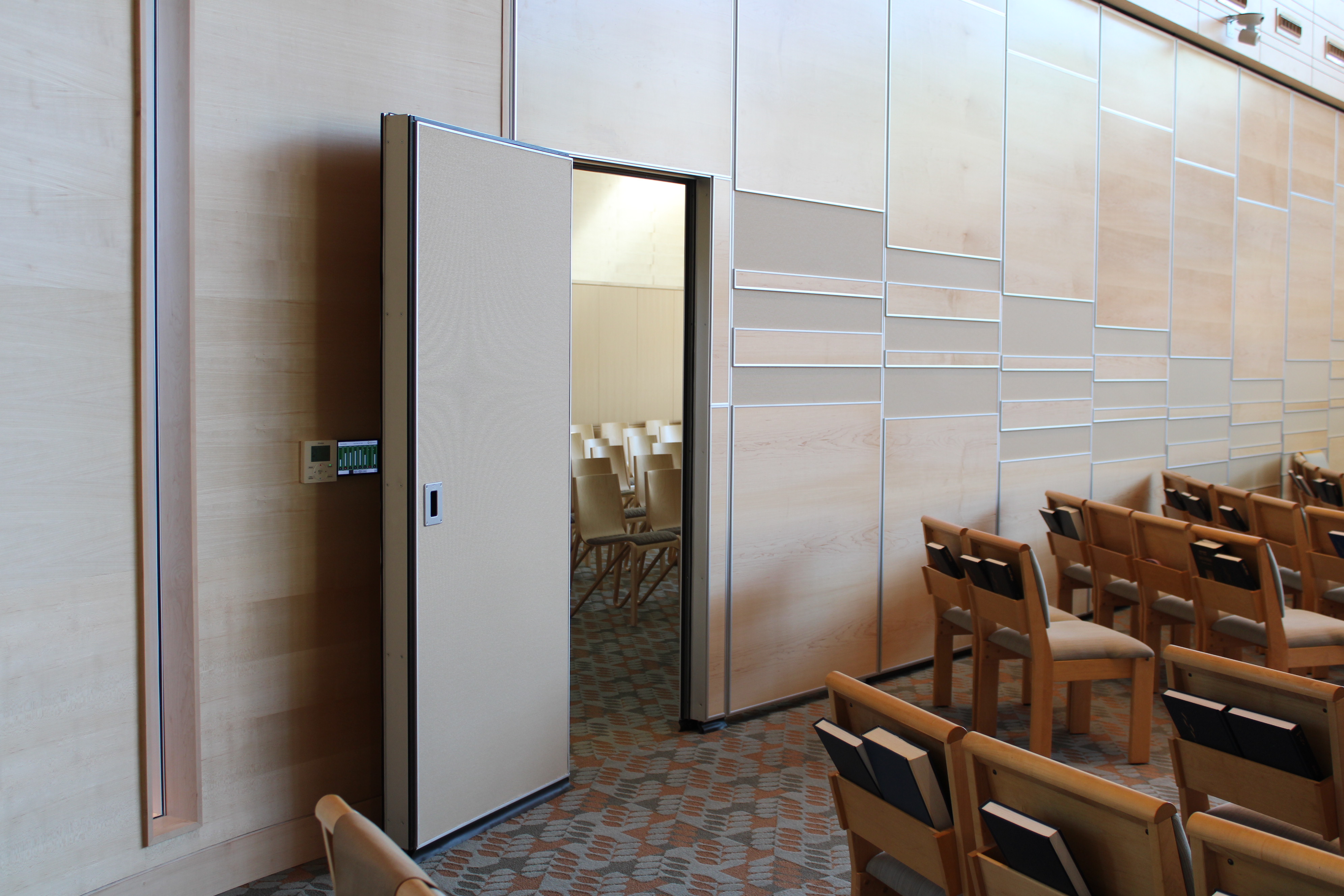
Questions congregations ask us
Will one service be audible through the wall during another?
Our all-steel panels carry field-tested NIC 42 under ASTM E 336, with laboratory ratings to STC 54 — and we guarantee field sound ratings on our large operable walls. Sound test reports are in the document library.
Can the panels disappear completely when we need the full sanctuary?
Yes. Congregation Rodef Shalom uses a remote stack, which parks the panels away from the opening entirely. Temple Israel uses pocket storage with concealed SOSS hinges on the pass doors so the stored partition does not interrupt the room's sight lines.
Can the finish match the woodwork we already have?
Yes — the veneer at Temple Israel was custom matched to the temple's existing architectural woodwork. Rodef Shalom combines wood veneer with fabric on the same installation, which is common where one face reads to the sanctuary and the other to a fellowship space.
Our sanctuary is already echoey. Will a partition make that worse?
It does not have to. NIC and STC describe sound stopped between rooms; NRC describes sound absorbed within a room. Perforated ALPHA® 'P' faces are available to NRC 0.65 for exactly this — Rodef Shalom specified them for spoken-word clarity across every configuration.
Should we choose manual or electric if volunteers will operate it?
Temple Israel runs both on the same project: a bi-parting electric wall for the main division and a manual partition elsewhere. Electric suits large or frequently moved walls; manual is simpler to maintain and has nothing to fail. We compare them in manual vs. electric operable walls.
Serve Your Growing Congregation
Discover how our operable partition systems can help your worship facility adapt to changing ministry needs.